
I never really got Pee-wee Herman. Growing up in the UK in the 1980s, I only caught occasional MTV clips of him. He was a childlike nerd who played with American 1950s stereotypes that meant little to me. He also pulled a lot of faces and I’ve never liked characters who pull faces. I certainly did not expect to enjoy a three-hour documentary about him.
Pee-Wee as Himself, a two-part documentary from HBO, appeared on year-end lists from The New York Times, RogerEbert.com and The New Yorker. I decided I might be wrong about him, especially as the film was backed by the Safdie Brothers, filmmakers I have followed since the masterfully uncomfortable Uncut Gems.
The film runs just over three hours. It is assembled from 40 hours of interviews with Paul Reubens, the man who created and performed the character. It also features reams of Reubens’ personal archival footage from his years in art school, improvisational theatre, and his subsequent career in television and film.
Reubens’ Story#
In the 1970s, a wonderfully youthful and queer Reubens was working with the L.A. improv troupe The Groundlings where he developed Pee-wee Herman as one of this many bits. The character was a wannabe stand-up comedian with no comic timing or self-awareness. The act was a subversion of American cultural touchstones. It warped the aesthetic of 1950s kid shows like Howdy Doody and Captain Kangaroo. Pee-wee replaced the adult authority with a chaotic man-child, turned passive audiences into active co-conspirators, and swapped straight wholesome order for camp, surreal disorder.
It ran at midnight to a participatory crowd of loud, late-night revellers, mixing nostalgia with the anarchy and irony of the L.A. punk scene.
It could have ended there, a curiosity for the underground crowd. But Reubens was unapologetically ambitious. He moved the act to The Roxy Theatre on the Sunset Strip a more mainstream venue, which would showcase the show to agents, studio people, and critics.
It worked. HBO filmed the stage show in 1981, transforming a local hit into a national calling card. By 1985, Warner Bros. agreed to finance a feature film, albeit on a limited budget. Pee-wee’s Big Adventure was commissioned, and to direct, Reubens handpicked a Disney animator fresh off short films like Frankenweenie, Tim Burton.
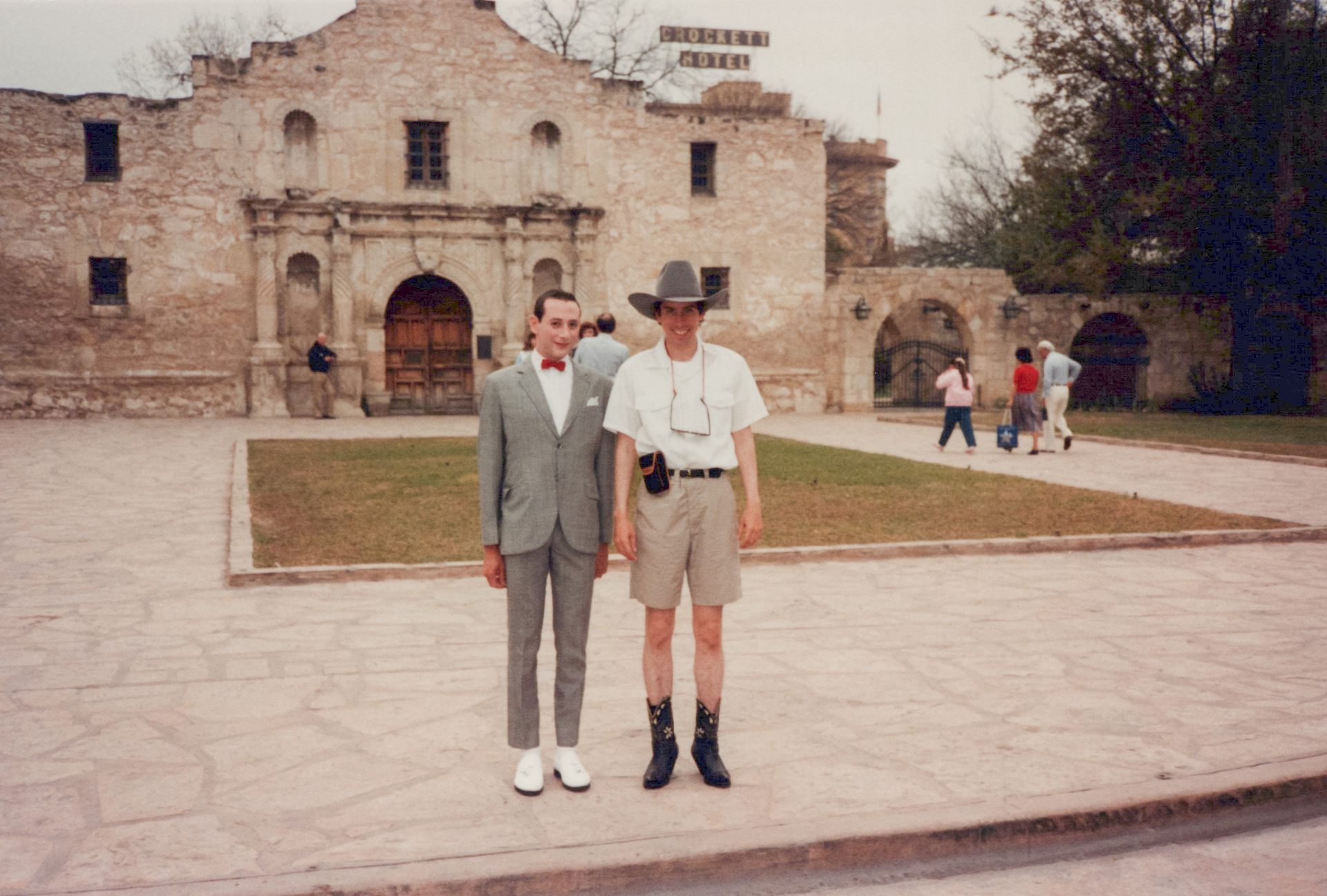
Children’s TV#
The movie was a surprise hit, proving the character could work outside a nightclub. CBS took notice. They approached Reubens to host a standard Saturday morning cartoon show. The deal was very limited, CBS had intended he provide interstitials between the animations. Reubens countered with a plan for a full live-action show, essentially a “real” version of the 1950s programmes he had been parodying.
CBS cautiously agreed, with the first season produced on a tight budget in a New York loft. Reubens hired underground comic artists and painters rather than professional set designers, which gave the the show it’s unique style.
Pee-wee’s Playhouse aired from 1986 to 1990. It populated its world with anthropomorphised furniturelike Chairry, Jambi the wish-granting genie, Clocky the wall clock, and Globey the talking globe. But it also layered in adult jokes. There were shirtless builders, references to homoerotica, and adult absurdism.
The cast included Laurence Fishburne as Cowboy Curtis, and often featured guest appearances such as Cher, Little Richard, and Dolly Parton.
As set designer Wayne White recalled:
“We were all basically underground cartoonists. We’d just go into this little room and smoke weed and draw pictures all day long… Me and Gary and Rick made hundreds, maybe thousands of drawings, because Paul liked to see a lot of alternatives. He always picked out the weirdest stuff I did. And I love that, ‘cause usually, it’s the opposite.”
Working with Reubens was not always harmonious. Collaborators expressed frustration when their contributions went unrecognised. In the interviews Reubens reveals that he was deserate for validation; the public knew Pee-wee, but not Paul.
In the interviews, you see the friction with director Matt Wolf. Reubens jostles with him and vies for control, always suspicious of the directors’ intentions.
The Controversy#
Reubens’s distrust of the media has context. In 1991 he was arrested in a Sarasota adult cinema for indecent exposure. Adult cinemas were targeted by police at the time, and arrests often led to public naming, moral panic, and career damage. In 2001, a police search of his vintage erotica collection prompted further accusations. His attorney called it a homophobic witch hunt, noting that similar material sat in university LGBTQ archives.
This was the climate. Breaching accepted ‘propriety’ brought legal action and tabloid exposure. George Michael’s 1998 arrest had the same pattern, where a private consensual act became a national story. Homosexuality was routinely framed as deviance, and although attitudes have shifted the impact on careers and reputations was lasting.
Completion of the documentary#
On his last day, Reubens recorded audio for the film. He said he wanted “to let people see who I really am and how painful and difficult it was to be labeled something I wasn’t.” He died before the documentary was finished.
He was a private man, hiding a battle with cancer for six years from many people including the documentaries’ director. The tragedy of the third act remains, but I loved discovering Pee-wee Herman,what he built, what he meant to people.